
BY FULTON MAY SOLUTIONS
Most companies thinking about AI fall into one of two camps: the ones who jump in without a plan and the ones who never start because the whole thing feels too complex.
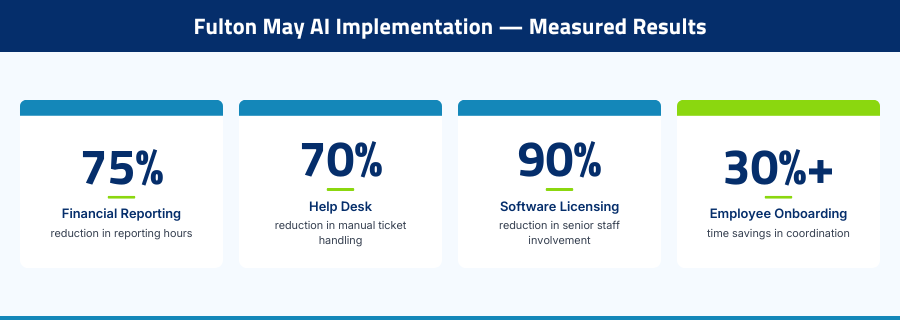
At Fulton May Solutions, we took a different path. Before we ever offered AI implementation to a client, we ran it as an internal experiment — on ourselves, with our own systems, on our own dime. That was early 2024. Eighteen months later, we’ve cut financial reporting hours by 75%, reduced manual help desk work by 70%, and freed up senior staff from tasks that used to interrupt them 20 times a day. Here’s what we did, what surprised us, and what it means for businesses like yours.
Why We Started Internally
When AI started gaining real momentum, we were hearing two things from clients: curiosity and concern. Everyone wanted to know what AI could do. Nobody wanted to be the guinea pig.
Our COO, Dave Nazha, put it plainly: “There are a lot of companies positioning themselves as AI consultants, or just trying to private label an AI tool to sell. We knew that we could provide our clients with an AI solution, but we didn’t want to pilot anything with them that we hadn’t already done for ourselves.”
So in early 2024, our leadership team made a deliberate call: experiment with AI internally first. No client pressure, no promises — just real implementations in our own business to see what actually worked.
Our founder, John Sikaras, set the tone from the start: there would be no rushing. “There are plenty of AI consultants who tell companies, ‘Give us $150,000 and we’ll automate everything for you,'” John said. “I don’t believe in that. I believe in slow and steady. We started with the low-hanging fruit to see what AI could do for our organization, and then built out from there.”
What We Automated — And What It Changed
FINANCIAL REPORTING
Our Controller, Kristie Pechtel, was spending between 17 and 22 hours each month preparing executive financial summaries by hand — pulling spreadsheets, building presentations, writing talking points. She started using AI to analyze financial data, surface trends and anomalies, generate executive-ready summaries, and build PowerPoint presentations automatically from raw inputs. The same work now takes 4 to 5 hours a month.
“As an accounting person, I was a little hesitant to put my toe in the waters of automation,” Kristie said. “But I’ve been blown away by what AI can do. I’m able to plug any kind of raw data into it, and the intuitive thinking it does for me is amazing.”
HELP DESK AND TICKETING
Our Managed Services team automated core functions inside their ticketing system: auto-formatting incoming service requests, assigning priority levels and SLA categories, routing tickets to the correct team, and triaging support queues automatically. The result was a 70% reduction in manual ticket handling.
SOFTWARE LICENSING
Previously, only a handful of administrators could approve or assign Microsoft licenses — which meant senior engineers were interrupting their actual work to handle licensing requests up to 20 times a day. Automated workflows now handle the entire process, from validation to assignment. Senior staff involvement in licensing dropped by 90%.
“When you’re having to purchase new licenses 20 times a day, it consistently takes you away from what you’re focused on,” said Eric Nickel, our Director of Managed Services. “Now we’re not impacted by this at all because the automation does everything for us.”
EMPLOYEE ONBOARDING
One of our larger internal builds was a full onboarding automation using Power Automate. When a new hire form is submitted, the system automatically generates a ticket, extracts and categorizes onboarding information, distributes tasks to the right teams, and generates checklists — with full leadership visibility into timelines. The result: more than 30% time savings in onboarding coordination.
OPERATIONAL DASHBOARDS
For Dave, one of the most meaningful implementations was connecting our operational systems — ticketing, accounting, security tools, PSA platforms, reporting dashboards, vendor systems — into a single AI-connected view. Instead of pulling reports from six different places, executives can ask questions and get synthesized answers in real time.
“Not long ago, analyzing Excel reports meant going line by line, one file at a time — a process that could eat up an hour or more,” Dave said. “Now I upload those same reports directly to our AI tools and get exactly what I’m looking for: flagged exceptions, patterns, outliers. The time I get back goes right back into running the business.”
What This Means for Your Business
Fulton May’s internal AI experience wasn’t just about efficiency. It gave us something more valuable: a real, tested methodology we can now bring to our clients.
“Our experiences with our own AI implementation make us the perfect partner to do this work for our customers,” Eric said. “After being on this journey for many, many months, we’ve gained a lot of experience that directly benefits our customers — not just in the implementation of AI but also in measuring and tracking how the implementations are actually improving efficiencies.”
The approach we follow with clients mirrors what we did ourselves: start with a discovery survey to understand how AI is currently being used (if at all), align on desired outcomes, deliver prioritized recommendations, and then build workflows around what will actually move the needle for your business.
“AI is like having your own personal assistant. It takes away a lot of the annoying parts of your job and allows you to think differently and more strategically, and try out different things. It’s also helped my people work faster and more easily, and ultimately helped them grow.”
— John Sikaras, Founder, Fulton May Solutions
Most companies don’t need a $150,000 transformation project. They need someone who has been through the process, knows where to start, and can build the right workflows for their specific goals. That’s what we’ve learned to do — because we had to figure it out for ourselves first.
Ready to See What AI Can Do for Your Business?
Fulton May Solutions’ Strategic Development & AI Implementation service helps businesses identify, implement, and measure AI automations that fit their operations and goals — using the same slow, steady, strategic approach we used ourselves.
Contact us to start the conversation