
BY FULTON MAY SOLUTIONS
Manufacturing IT has changed more in the last three years than in the previous decade.
It’s not that the technology is different — it’s that the stakes are different. What used to be a back-office support function is now a direct factor in whether production lines stay running, whether customers receive their commitments on time, and whether your business can compete.
If you run a manufacturing operation and you haven’t revisited how IT is managed in the last 12-18 months, here are four things worth knowing.
1. Your shop floor and your office are now the same attack surface
Most manufacturers have two separate technology worlds: the shop floor (operational technology — PLCs, SCADA systems, IIoT sensors) and the office (information technology — ERP, email, cloud systems).
These worlds used to be separate. They aren’t anymore.
As manufacturers connect production systems to corporate networks — for real-time data, remote monitoring, and ERP integration — they create a unified environment. That’s good for efficiency. It’s also good for ransomware.
Manufacturing is the most-targeted sector for ransomware attacks. A production stoppage from a security incident can cost more in a single day than a year of proactive IT investment. And most standard IT providers don’t have the expertise to secure OT/IT environments — it’s a specialized problem that requires understanding both worlds.
2. Your customers are starting to ask about your security posture
If you work with larger OEM customers, prime contractors, or companies with federal supply chain involvement, you’ve probably already seen this: security questionnaires from customers who want to know if their suppliers are protected.
This trend is accelerating. Customers are increasingly requiring suppliers to document their security controls, demonstrate backup and recovery capabilities, and prove they can withstand a cyberattack without disrupting commitments.
A manufacturer who can answer those questions confidently has a competitive advantage. One who can’t is a liability in a customer’s supply chain.
3. Multi-site consistency is harder than it looks
Many manufacturers have grown by adding facilities over time. Each plant may have been set up differently, with different hardware, different configurations, and different levels of security and support.
That inconsistency creates real risk. An unprotected edge site can be the entry point for an attack that spreads across your entire operation. A new plant that doesn’t meet your IT standard is a vulnerability from day one.
Standardizing infrastructure across multiple locations — so every site has the same baseline — is one of the highest-value things a manufacturing IT partner can do. It also happens to be one of the most commonly overlooked.
4. AI has real, near-term applications in manufacturing — but most IT providers can’t guide you there
Every manufacturing leader is hearing about AI. Most are unsure where to start.
The honest answer is that most standard IT providers can’t help you here. They were built to maintain infrastructure — not to design intelligent workflows, build AI governance frameworks, or integrate AI tools with your production data.
The opportunity is real and near-term. Shop-floor-to-boardroom data integration, ERP workflow automation, predictive maintenance, and AI-assisted quality control are all achievable for mid-sized manufacturers in 2026. The barrier isn’t the technology — it’s having an IT partner who knows how to apply it to your specific environment.
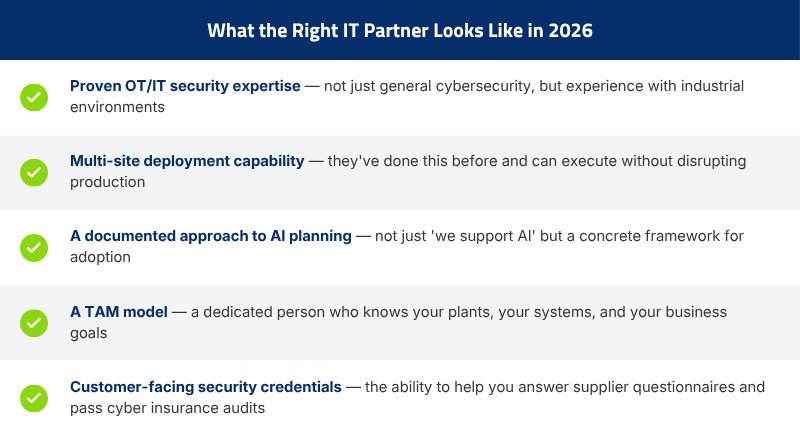
What the right IT partner looks like in 2026
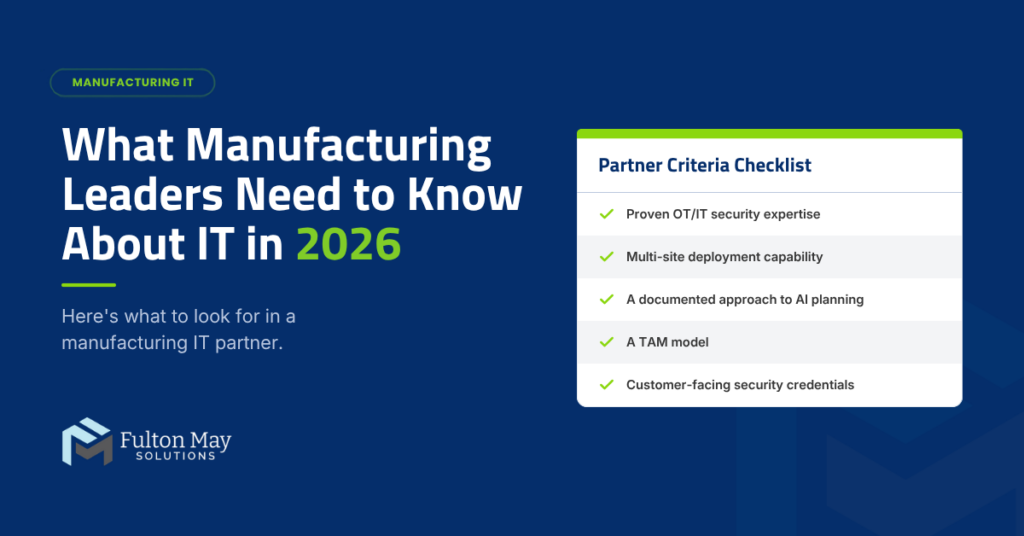
Given these four realities, here’s what to look for in a manufacturing IT partner:
- Proven OT/IT security expertise — not just general cybersecurity, but experience with industrial environments
- Multi-site deployment capability — they’ve done this before and can execute without disrupting production
- A documented approach to AI planning — not just ‘we support AI’ but a concrete framework for adoption
- A TAM model — a dedicated person who knows your plants, your systems, and your business goals
- Customer-facing security credentials — the ability to help you answer supplier questionnaires and pass cyber insurance audits
If your current IT provider can’t check most of those boxes, the gap between what you have and what you need is worth taking seriously.
Fulton May Solutions is a TMA sponsor and a Managed IT Intelligence partner for manufacturers across the Midwest. If you want to talk about where your operation stands against these four areas, Steve Liss is the right place to start.