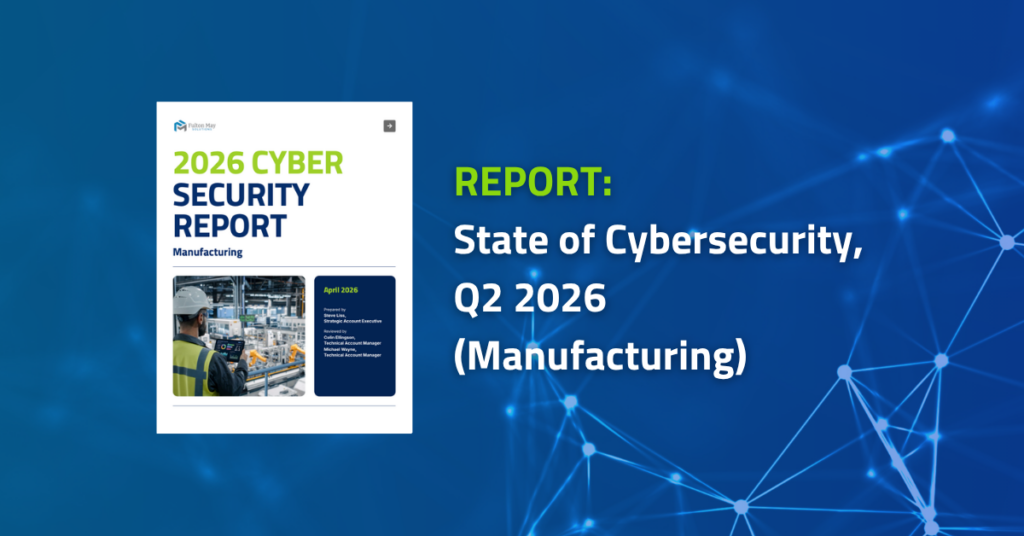

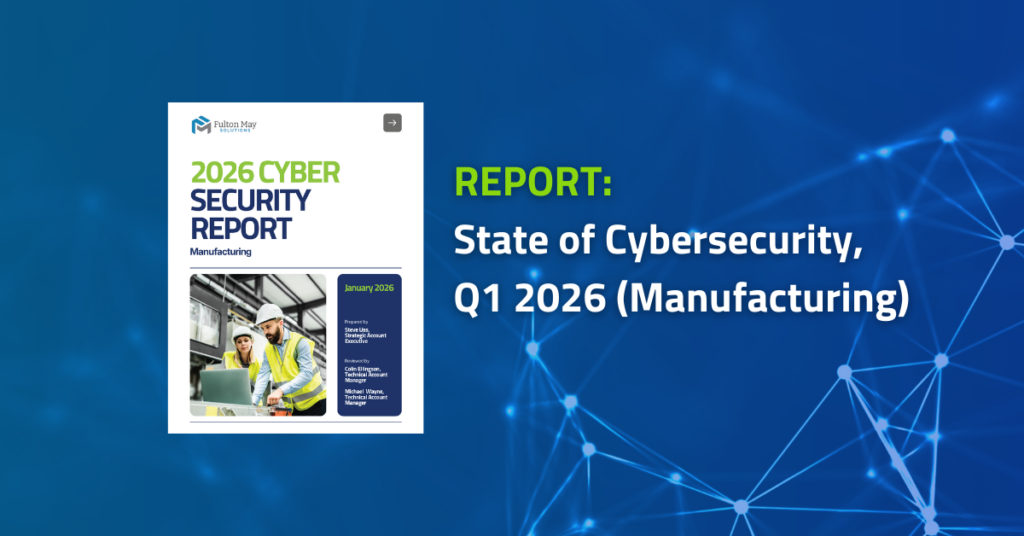
Manufacturers are under growing pressure to modernize, connect plants, and support remote work and vendor servicing—all without interrupting production. Fulton May Solutions’ new State of Cybersecurity Report, Q1 2026 (Manufacturing) shows how that pressure is reshaping cyber risk on the plant floor and in the back office.
Drawing on frontline incidents, support tickets, and project data from small and mid-sized manufacturers across the United States, the report highlights a clear theme: uptime is now directly tied to how well plants control a small set of high-impact systems and access points. Attackers are increasingly targeting these weak links to create maximum disruption with minimal effort.
Why manufacturing cyber risk is changing in Q1 2026
In many manufacturing environments, risk is no longer driven primarily by exotic attacks or niche vulnerabilities. Instead, it is rising for familiar, operational reasons:
- More connectivity between OT and IT systems to support real-time monitoring, maintenance, and reporting.
- More third-party remote access for equipment vendors, integrators, and specialized support partners.
- More strain on lean internal teams who are tasked with keeping everything online, often with limited time for documentation and proactive security improvements.
The Q1 2026 report found that attackers are taking advantage of the same efficiencies that help plants run smoothly—using remote tools, poorly governed access, and lightly monitored systems to move quickly and quietly.
Key findings for plant and IT leaders in Q1 2026
This quarter’s manufacturing cybersecurity data points to a handful of priority areas where small changes can prevent costly downtime. Among the most important findings:
- Remote entry points have become critical uptime dependencies. Vendor tools and remote access paths are now woven into daily operations, from line diagnostics to ERP support. The report notes that when these pathways are not tightly constrained, monitored, and regularly reviewed, they often become the first foothold for attackers—and a fast route to disrupting production.
- Backups are frequently treated as an IT checkbox, not a production safeguard. Across many plants, backup systems exist but have not been tested for real recovery speed. The report emphasizes that when restore time is unknown or unproven, recovery becomes a business gamble. For manufacturers that operate on thin margins and tight schedules, uncertainty around recovery time is now a top operational risk.
- Limited visibility is slowing response and driving longer outages. Many SMB and mid-market manufacturers still lack a current view of what is connected to the network, who has access, and what has recently changed. The Q1 data shows that incidents take significantly longer to contain when teams must first spend hours piecing together inventory and configuration details.
- Compliance and customer scrutiny are intensifying. Even when formal regulations vary, manufacturers—especially those serving healthcare, construction, legal, and other critical sectors—are being asked to demonstrate responsible access control, backup and recovery readiness, and incident response capability. The report anticipates this pressure will continue to build through 2026.
- Incremental improvements are delivering outsized impact. Not every plant can afford major rearchitecture or prolonged downtime windows. The report documents cases where focused steps—such as tightening remote access policies, segmenting a small set of critical systems, or validating backup restores—meaningfully reduced risk without disrupting production.
What is different about Q1 2026
Compared to previous quarters, the Q1 2026 findings highlight a shift from theoretical risk to very practical, operations-focused concerns:
- Remote access is now embedded in nearly every major plant function. This quarter, more manufacturers report that production and maintenance workflows depend on remote tools—making any compromise of those channels a direct threat to uptime.
- Ransomware remains present, but the bigger story is recovery readiness. Fulton May Solutions’ team saw fewer “headline” attacks but more instances where untested backups and unclear responsibilities turned minor issues into extended outages.
- Security responsibilities are increasingly shared between IT and operations. The report notes more cross-functional involvement—but also more confusion—around who owns which safeguards, especially at plants where IT staff are stretched thin or partially outsourced.
For SMB and mid-market manufacturers, these trends reinforce a key takeaway: cybersecurity decisions are now production decisions. The cost of inaction is measured in hours of downtime, missed shipments, and strained customer relationships—not just in technical metrics.
How manufacturers can act on the findings
The full Q1 2026 Manufacturing State of Cybersecurity Report translates these trends into a short, prioritized action list specifically designed for small and mid-sized plants. Recommendations focus on steps that reduce downtime risk quickly, without requiring a complete overhaul of existing systems.
Examples include:
- Establishing clear rules and monitoring for vendor and third-party remote access.
- Testing restores from existing backups and documenting realistic recovery times.
- Improving basic visibility into connected assets and recent configuration changes.
- Aligning IT and operations leaders around a shared view of critical systems and acceptable downtime.